Quality engineering that catches failures before your users do
Test automation services, exploratory QA, security testing, and CI/CD quality gates, built around the way your team already ships. We start from the failures you can't afford, not from a tool.
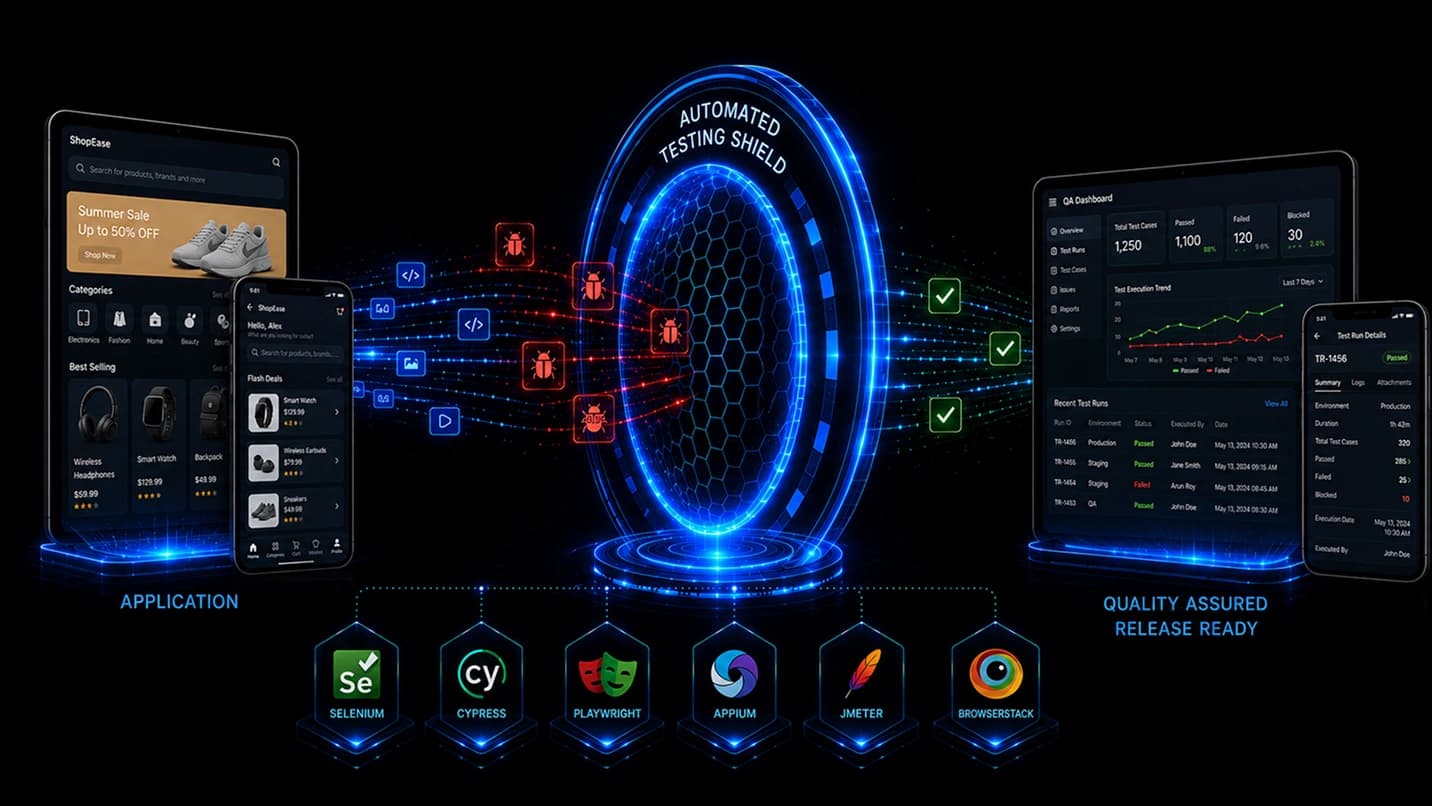
Technologies used
Quality engineering, explained
Testing is a task. Quality engineering is the decision about which failures you can afford and where you catch them. Here is how we think about that, before anyone writes a script.
What is quality engineering?
Software quality engineering is the practice of building quality into how software gets made, rather than inspecting for it once the build is done. Traditional QA is a stage between code complete and release. Quality engineering spreads the same work across the whole delivery lifecycle: requirements written so they can be verified, code shipped with tests beside it, environments that behave like production, and a pipeline that says no when something regresses.
The shorthand for that shift is shift-left testing. Move each check as close as possible to the moment the mistake is made, because a defect caught in a pull request costs a conversation, and the same defect caught by a partner's finance team costs a release, a hotfix, and some trust. Digital quality engineering extends the idea past the application to everything around it, the APIs, the integrations, the data, and the deployment path, which is where modern products actually break.
Continuous testing and DevOps testing
Continuous testing means the suite runs because code changed, not because someone remembered to run it. In a DevOps testing model the pipeline owns that: a fast smoke pack on every commit, full regression on merge, and performance and security checks on a cadence that matches how quickly those risks move. Continuous quality engineering applies the same discipline to the practice itself, so coverage, run time, and flake rate are tracked and tuned like any other production system.
The gate matters more than the coverage number. A pipeline that fails builds nobody believes in gets routed around within a fortnight, and after that the suite is decoration. We would rather start with a small set of checks a team trusts enough to block a deploy and grow from there than deliver a large suite everyone learns to ignore.
Where AI-augmented test automation helps
AI-augmented test automation earns its place in three jobs: drafting candidate test cases from requirements, keeping element locators working when the interface moves underneath them, and triaging a failed run down to a root cause instead of a wall of red. All three attack maintenance, and maintenance is what kills automation programmes.
It has no business deciding what correct means. Assertions stay deterministic and human-owned, and a generated test is a draft until an engineer has read it. We use the AI layer to make a suite cheaper to keep, never to decide whether a release is safe.
Automated unit test generation for Java
Tools like Diffblue Cover read a Java codebase and write JUnit tests against it, working from the code paths they can observe rather than from a specification. That makes them genuinely useful in one situation: a legacy service sitting near zero coverage, where the goal is a safety net before a refactor and hand-writing several hundred tests is a quarter of work nobody is going to fund. Run as a plugin inside IntelliJ IDEA, or driven from the command line for teams on other editors, it turns an afternoon into a baseline suite.
Knowing where the tool stops matters more than knowing how to run it. Generation is pinned to particular Java versions, gRPC coverage thins out quickly, and anything the generator cannot execute during analysis simply never gets covered, so a coverage percentage can climb while the risky path stays untested. A generated test also encodes what the code currently does, which only matches what it should do if the code is already right. We treat the output as a draft: engineers review it, keep the assertions that describe intended behaviour, and delete the rest.
QA consulting comes before scripts
Most teams asking for test automation do not need coverage everywhere. They need to know which failures would cost them the most and which of those are currently caught by nobody. That is the QA consulting half of this work: a read of your release history, defect patterns, existing tests, and pipeline, ending in a test automation strategy that says what to automate first, what to leave manual, and what to fix in the product before any of it is worth automating.
Testability is usually where that lands. An application without stable selectors, seedable test data, or an environment you can reset is expensive to automate and stays expensive. Fixing that first is unglamorous, and it is the difference between a suite that compounds and a suite that gets deleted in year two.
Manual QA has not gone anywhere
Automation is good at the same check performed a thousand times. It is poor at noticing that a screen is technically correct and practically unusable, and it never finds the bug nobody thought to write a test for. Exploratory testing by someone who understands the domain still surfaces defects no suite will, which is why manual QA is a pillar of this service rather than the thing automation is meant to replace.
The split is straightforward. Regression, smoke, API, and load work belongs to machines. Judgment, first-run feature testing, accessibility review, and messy real-device scenarios belong to people. The manual work in our own delivery portfolio has looked exactly like that: validating live session flows, streaming events, and embedded integrations by hand, where the failure was a sequence of events rather than a wrong value.
What we cover
Test automation
Framework-agnostic automation across web, mobile, and API layers, built as a maintained codebase rather than a pile of scripts. Page objects, generated test data, and parallel runs, in Selenium, Playwright, Appium, or the test automation framework your team already runs.
Automated unit test generation
Diffblue Cover and the JUnit tooling around it, pointed at legacy Java services where coverage sits near zero and hand-writing the suite is a quarter of work nobody is going to fund. Generated tests arrive as a reviewed pull request rather than a merge: we read what the tool wrote, keep the assertions that describe intended behaviour, and delete the ones that only describe current behaviour.
API testing
API testing and API automation testing at the layer where most of the logic actually lives: contract checks, status and schema assertions, auth and permission paths, and the negative cases nobody demos. Cheaper to write and faster to run than the same coverage driven through a browser.
Mobile app testing
Mobile test automation on Android and iOS with Appium, plus real-device work for everything emulators get wrong: permissions, camera and media handling, push notifications, network transitions, and background state.
Performance testing
Load testing, stress testing, and scalability testing with JMeter, k6, or Gatling. We find the breaking point, the resource that causes it, and the concurrency you can actually serve, before a campaign finds it for you.
Security testing
Security testing inside the delivery pipeline: dependency and secret scanning, static and dynamic analysis, auth and access-control review, and verification that sensitive traffic is encrypted and payment callbacks are cryptographically checked before anything is written.
CI/CD test integration
Tests as a pipeline stage, not a manual step. Smoke runs on every commit, regression on merge, results reported where your team already looks, and a build that fails on the failures you decided should block a deploy.
Continuous testing
Continuous testing keeps the gate alive as the product moves: coverage tracked against risk, run time kept short enough that nobody routes around it, and flaky tests treated as defects with owners rather than as noise.
Manual and exploratory QA
Structured exploratory testing, real-device checks, and first-run feature validation by testers who learn your domain. This is the work that finds the defect nobody thought to write a test for.
QA consulting and test strategy
QA consulting that starts with your release history and defect patterns rather than with a tool. You get a test automation strategy naming what to automate first, what stays manual, and what to fix in the application before automating anything.
Test automation by industry
Quality work from our delivery portfolio
Anonymized summaries of engineering work where quality was the constraint. Client names are withheld until each partner confirms public use, and we don't publish numbers we can't source.
- Problem
- A fintech merchant payments app moved UPI transactions, settlement data, and loan applications across public networks, so transport-level protection had to hold for every sensitive call rather than for a handful of endpoints someone remembered.
- Approach
- We treated the API surface as one problem and put a single interceptor in front of it, making encryption a property of the transport layer instead of something each feature team implemented again slightly differently.
- Engineering proof
- Hybrid encryption on all sensitive API traffic: AES-256-GCM for the payload with an RSA-wrapped key in a standard envelope format, applied uniformly rather than per endpoint.
- Stack
- Flutter, Dart, BLoC, custom HTTP interceptor, AES-256-GCM, RSA
- Problem
- On a travel-planning web platform, payment callbacks arriving from a gateway can be forged, and an order written before the callback is verified is an order the business cannot defend later.
- Approach
- Verification moved server-side into a backend-for-frontend layer, and two identity systems were reconciled so the session that pays is the session the order is written against.
- Engineering proof
- HMAC-SHA256 signature verification on every payment callback before an order is persisted, with gateway secrets held server-side rather than shipped to the browser.
- Stack
- Next.js, TypeScript, headless CMS, payment gateway, HMAC-SHA256
- Problem
- A live-session wellness widget driven by asynchronous server events could land in interface states no test case anticipated, and it had to behave identically once embedded inside a host mobile app.
- Approach
- The session was modelled as an explicit state machine, which turns a question like what happens if the trainer connects twice from a bug report into a transition you can name and check.
- Engineering proof
- Exploratory QA across success, completion, and interruption scenarios, with streaming events and the embedded integration validated by hand on the host app.
- Stack
- React, XState, gRPC streaming, WebView embedding
Talk to the engineers who'd own your test strategy
Tell us what you're shipping and where it breaks. You'll get a scoped first phase, a fixed cost for it, and the test strategy behind both.
Prefer we come to you? Fill in the form below.
Tell us where to reach you
Takes under a minute. An engineer reads it, not a lead-scoring tool.
QA outsourcing, a dedicated QA team, or an in-house hire?
| Factor | CodePrism | In-house hire | Freelance / body shop |
|---|---|---|---|
| Time to start | Days. A QA team that has set this up before. | Weeks to months to hire a QA automation engineer. | Fast, though depth varies by individual. |
| Test automation strategy | Strategy, framework, and suites from one team. | Shaped by whoever you hire first. | Usually scripts against someone else's strategy. |
| Web, mobile, and API coverage | One team across all three layers. | Rarely one person's skill set. | Typically strong on a single platform. |
| Working with your existing QA | QA team augmentation: our engineers join your stand-ups and your tracker. | The same team by definition. | Coordination stays your job. |
| Ramp-down flexibility | Scale up for a release, down after it. | Fixed headcount either way. | Available until they are not. |
| Communication overhead | One accountable team on your working hours. | Direct, in the room. | Fragmented across individuals. |
| Cost predictability | Scoped per phase and agreed before we start. | Salaries, tooling, and devices as fixed cost. | Low day rate, higher rework risk. |
| Who owns the suite | You do. Repositories, frameworks, and pipelines, documented for whoever inherits them. | Yours. | Negotiated case by case. |
Our approach
Assess
We audit what is already there: release history, defect patterns, existing tests, pipeline maturity, and how testable the application actually is. You get a written view of where quality is failing and what it costs you, before anyone proposes a tool.
Architect
Test automation strategy and framework design matched to your stack and release cadence, covering tool selection, test environment setup, and test data management. We agree what gets automated, what stays manual, and what has to block a deploy.
Automate
We build the suites and wire them into your pipeline, starting with the highest-risk flow so something real is gating a deploy in the first phase. Everything lands in your repository and is reviewed like production code.
Optimize
Coverage grows, run time comes down, and flaky tests get fixed instead of re-run. As the product changes, the regression pack changes with it, which is the part most automation programmes skip and the reason most of them are abandoned.
Want a suite you can trust on release day?
Send us your stack, your release cadence, and the failures that hurt most. We'll come back with the coverage plan, the automation targets, and what the first phase costs. Thirty minutes with engineers, not a sales team.
Prefer we come to you? Fill in the form below.
Tell us where to reach you
Takes under a minute. An engineer reads it, not a lead-scoring tool.
Frequently asked questions
What are QA automation services?
QA automation services cover the work between a feature being written and someone trusting it in production. In practice that is four things: a test automation strategy that decides what is worth automating and what is not, a test automation framework built against your application rather than lifted from a template, the suites themselves across functional, regression, API, and mobile layers, and CI/CD test integration so those suites run on every commit instead of on request. We deliver all four as engineering work, with a repository, code review, and documentation, not as a folder of scripts handed over at the end.
How much do test automation services cost?
Cost tracks three things: how many platforms need coverage, how testable the application already is, and whether you need a framework built from scratch or an existing suite rescued. Automating one critical flow on a single web app is a different number from a programme covering web, mobile, and API layers with performance testing and security testing on top. We don't publish a rate card, because a range wide enough to be safe is too wide to be useful to you. Tell us what you're shipping and where it hurts, and you get a proposal with a scoped first phase, a fixed cost for that phase, and a running cost model that separates our fees from the tooling and device infrastructure you'll pay for directly.
What is the difference between traditional and AI-augmented test automation?
Traditional test automation is deterministic. An engineer writes a script, the script asserts a known expectation, and the suite fails when reality diverges from it. AI-augmented test automation adds a layer on top of that: models draft candidate test cases from requirements, keep element locators working when the interface shifts underneath them, and triage a failed run so a human reads the three failures that matter instead of the whole wall of red that shares one root cause. What the AI layer does not do is decide what correct means. Assertions stay deterministic and human-owned, because a suite that can talk itself into passing is worse than no suite at all. We point AI at maintenance and triage, which is where automation programmes actually die.
Can you generate unit tests automatically for our Java codebase?
Yes, and it is one of the few places automated generation clearly pays. Diffblue Cover analyses a Java codebase and writes JUnit tests against the code paths it can observe, running as a plugin inside IntelliJ IDEA against a project that compiles and already declares a JUnit dependency. The situation it fits is a legacy service sitting near zero coverage where you need a safety net before a refactor, and hand-writing several hundred tests is a quarter of work nobody is going to fund. We run the generation, then review the output as a pull request rather than merging it, because a generated suite that nobody has read is coverage on paper and nothing more.
What are the limits of automated unit test generation?
Four worth knowing before you budget for it. Generation is pinned to particular Java versions, so an older or newer runtime can mean changing the project's Java version before anything runs at all. gRPC support thins out quickly, and controller-level tests involving StreamObserver are largely out of reach. The generator only covers what it can execute during analysis, so code paths it cannot reach stay untested while the coverage percentage still climbs, which is the failure mode that matters most. And a generated test encodes what the code currently does, not what it should do, so it locks in a bug just as faithfully as correct behaviour. None of that makes the tool a bad buy. It makes the review step non-optional, and it is why we treat generated tests as a draft an engineer signs off rather than as finished work.
Which tools and frameworks support test automation services?
The tools that carry most of this work are well established. Selenium and Playwright for browser automation, Appium for mobile test automation on Android and iOS, Postman and code-level HTTP clients for API automation testing, JMeter, k6, or Gatling for load testing, and Jenkins or GitHub Actions to run all of it on every commit. Tool choice matters less than the framework design around it. We start from whatever your team already runs, because a suite nobody on your side can maintain is a liability with a maintenance contract attached, and we only recommend moving tools when the current one is the actual constraint.
What tests should be automated?
Automate what is repetitive, deterministic, and expensive to get wrong. Regression testing comes first, because it is the cost that grows with every release you ship. Smoke testing comes next, so a broken build is caught in minutes rather than in tomorrow's stand-up. Then the API and integration testing layers, which are cheaper to write and faster to run than the same coverage driven through a browser. End-to-end testing earns a place for the handful of journeys that carry revenue and no more than that, because sprawling end-to-end suites are the first thing to turn flaky and the first thing a team learns to ignore. Exploratory work, one-off checks, and anything whose expected result is still being argued about stay manual. Automating an unsettled requirement just freezes the argument in code.
How do you keep a test automation suite maintainable?
Maintenance is the whole game. Most suites are abandoned because they cost more to keep running than the defects they catch are worth. We separate test intent from implementation, so an interface change touches one page object instead of every test that walks through that screen. Test data is generated and cleaned up per run rather than depending on a shared environment somebody else is also using. Flaky tests are treated as defects with owners, not as noise to re-run, because a suite people re-run until it goes green has already stopped being a quality gate. The framework ships with documentation written for the engineer who inherits it, since the point is that your team can extend it without us.
How does test automation integrate with our existing CI/CD pipeline?
CI/CD test integration means the suite runs as a stage in the pipeline you already have, whether that is Jenkins, GitHub Actions, GitLab CI, or whatever your team standardised on. Smoke tests run on every commit and finish fast enough that nobody routes around them. The full regression pack runs on merge to your main branch or overnight, depending on run time. Results land where your team already looks, and the build fails on the failures you decided should block a deploy, which is a policy we settle with you rather than a default we impose. Continuous testing only works when the gate is trusted, so we would rather gate on a few checks people believe than on everything at once.
How does outsourced QA work alongside our in-house team?
QA outsourcing fails when it becomes a separate department with its own backlog and its own version of done. We work as QA team augmentation by default: our engineers join your stand-ups, your board, and your repositories, and defects go into your tracker rather than into a status report. Where there is no QA function yet, we run as a dedicated QA team, set the practice up, and hand it across as your own hires land. Either way the test suite lives in your repository from the first commit and the definition of done is agreed with your engineering lead, not with us.
Can we try the service before committing to a longer engagement?
Yes, and we prefer it. The first phase is deliberately small: one high-risk flow, on one platform, automated and running in your pipeline, so you can judge the code and the working relationship on real output rather than on a proposal document. Everything sits in your repository from the first commit, so if you stop there you keep what was built. What that phase covers, and what it costs, is agreed before we start.
How do you handle testing across web, mobile, and browsers?
Each layer gets the tool that suits it, and all of them report into one place. Cross-browser testing and compatibility testing run the same suite across the browser and version matrix your analytics say your users are actually on, rather than across every combination that exists. Mobile app testing runs on real devices for the things emulators get wrong: permissions, camera and media handling, push notifications, network transitions, and background state. Underneath both, the API and integration testing layer carries as much of the coverage as it can, because a check made at the API layer will always be faster and less brittle than the same check driven through a user interface.
What support can we expect after the suite is live?
A test suite is code, and code needs an owner. Ongoing support usually covers keeping tests current as the product changes, adding coverage for new features, investigating failures, and tuning run time as the pack grows. Some partners keep us on a retainer for exactly that. Others take it in-house, in which case the handover includes walkthroughs of the framework, the documentation, and a period where your engineers write the tests and we review them. Both are fine. What we won't do is build something only we can operate.
How does bringing in test automation affect our existing QA team?
It changes what they spend the day on, and it should. Manual regression passes are the least valuable use of a good tester and the first thing worth handing to a machine. What that frees up is exploratory testing, edge cases, usability judgment, and the domain knowledge that tells you which failure would actually hurt the business, none of which a script produces. In most teams the existing testers become the people who decide what gets automated and who own the test cases, and some move into writing the automation themselves. We're not replacing a team. We're removing the part of the job a pipeline does better.
Do you support testing in regulated and high-risk industries?
Yes. Test automation for healthcare and test automation for insurance carry requirements consumer software does not: evidence of what was tested, traceability from a requirement to the test that covers it, and controlled handling of production-like data in test environments. Test automation for fintech adds transaction integrity and payment-path security, which is the area our own engineering has gone deepest on. Test automation for retail is shaped by peak-season load and device breadth more than by compliance, and QA for telecom by integration surface and uptime. The four pillars stay the same everywhere. What changes is which of them takes the budget and how much of it has to be provable afterwards.
Explore our other services
Application development
We build the applications, so we know where they break. Testability designed in rather than retrofitted.
Learn moreMobile app development
Android and iOS builds from the same team that runs the device testing and release pipeline.
Learn moreGenerative AI
The AI engineering behind test generation, failure triage, and the models we put to work on maintenance.
Learn moreShipping with confidence starts here
Tell us what you're shipping and where it breaks. You'll get a scoped first phase, a fixed cost for it, and the test strategy behind both.
Prefer we come to you? Fill in the form below.
Tell us where to reach you
Takes under a minute. An engineer reads it, not a lead-scoring tool.