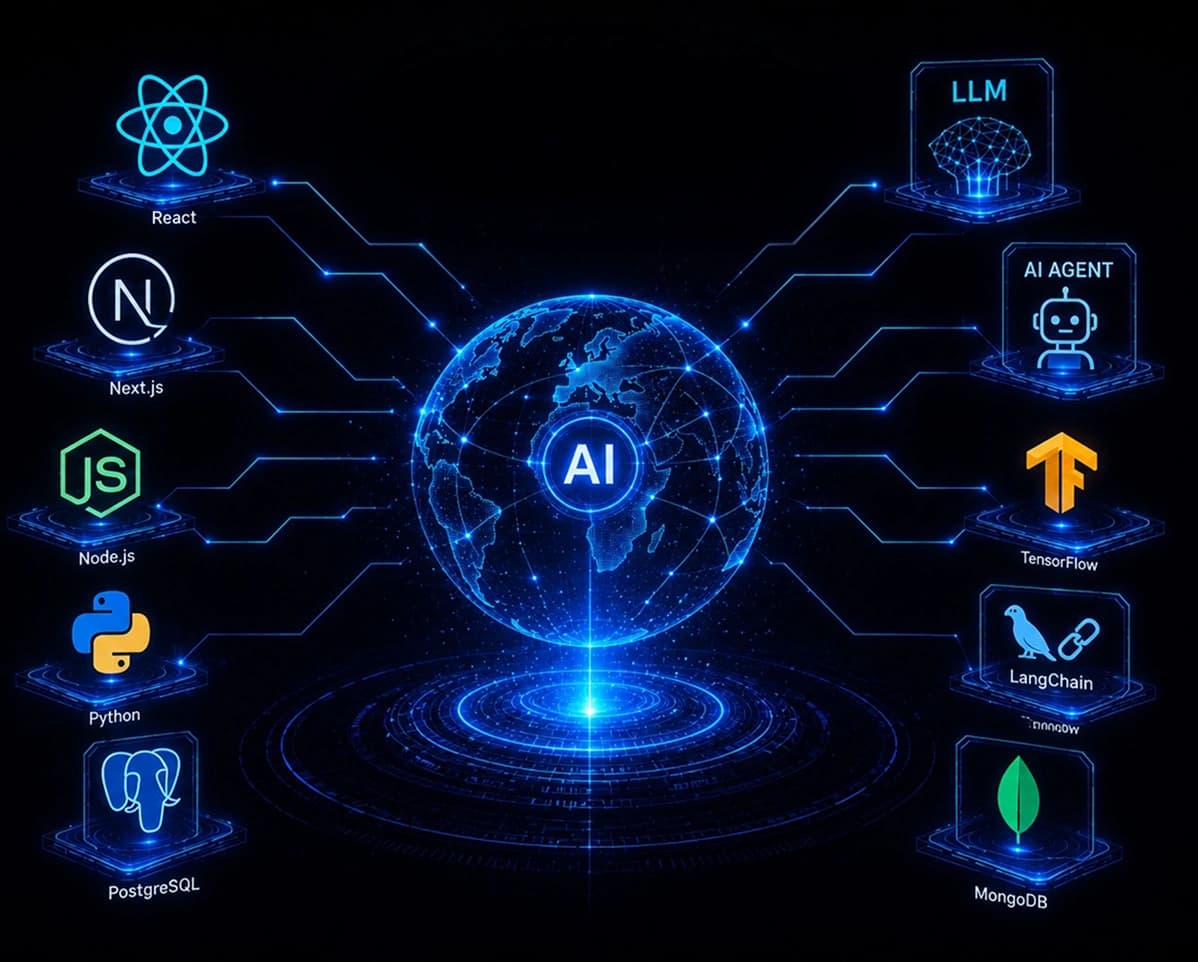
We consult, design, and build enterprise AI systems end to end: LLM applications, RAG pipelines, autonomous agents, and multilingual voice AI. The systems on this page cut one partner's per-minute cost by 60% and answer over company data with retrieval relevance four times better than naive search.
Model, framework, and vector store are architecture decisions, not preferences. We pick each one against your accuracy target, your cost per request, and where your data is allowed to live.
We build LLM-powered applications, enterprise AI systems, autonomous agents, voice AI, RAG architectures, AI workflow automation, and multilingual platforms. Here is how we think about the decisions that determine whether any of it survives contact with real users.
Why most AI projects stall after the demo
A prototype that answers well on ten hand-picked questions is a weekend of work. What breaks in production is everything around the model: documents that arrive as scanned PDFs with headers and page furniture, questions phrased nothing like the source material, users who ask follow-ups, and a business that needs to know why the system said what it said.
We build for that gap from the first sprint. Structured ingestion, evaluation on a held-out set of real questions, guardrails, and a designed escalation path are part of the initial build rather than a hardening phase bolted on when accuracy complaints start arriving.
Retrieval quality beats prompt tuning
Retrieval is where most deployments break, not generation. A model with a well-tuned prompt still answers wrong when the passages it receives are incomplete, off-topic, or stripped of the context that made them meaningful. Teams spend weeks on prompts and never touch the layer actually producing the errors.
The fix is unglamorous. An LLM preprocessing pass strips navigation furniture and chunks against document structure rather than a character count, carrying section headers inline so a chunk still makes sense retrieved alone. Queries expand into variants, search runs in parallel, and reranking drops near-duplicates. That sequence produced roughly four times the answer relevance of single-query top-K retrieval.
Agents as state machines, not prompt loops
One prompt doing retrieval, context assembly, and answer generation is quick to write and hard to fix. When it misbehaves there is no stage to isolate, and debugging turns into prompt roulette. It is also the reason agents wander off a defined process the moment a conversation goes sideways.
Our production agent systems run on LangGraph with explicit phase transitions and one responsibility per agent: retrieval and query expansion, context enrichment, response generation, and a grounding check that decides whether the system has the evidence to answer at all. Each is independently testable, and the interview platform built this way held complete script adherence across every candidate.
Where the models should actually run
Hosted frontier models are the fastest route to quality and the wrong answer for some workloads. Regulated data, sovereignty requirements, and per-request cost at volume all push inference toward models you run yourself, and the gap in capability has narrowed enough that this is now a genuine choice rather than a compromise.
We treat it as a dial rather than a decision. The learning platform we built pairs OpenAI gpt-4.1 with a self-hosted Llama 3.1 fallback so quality and cost control are separately adjustable. For Indian language work, Bhashini's sovereign stack covers 14 languages that commercial APIs either handle poorly or price out of reach at national scale.
What generative AI changes for the business
Cost that falls as volume rises
AI absorbs work that would otherwise scale with headcount, and owning the infrastructure keeps the unit economics yours. On one voice platform we built, per-minute cost dropped from Rs 0.50 to Rs 0.20 against a bill of over Rs 10 million a month.
Throughput a team cannot match
A campaign that would take a floor of people a week runs overnight. The systems we have deployed are engineered for 500,000 calls a day, and the same architecture handles a spike without a hiring cycle behind it.
Answers you can trace to a source
A confidently wrong answer on business data is worse than no answer. We build grounding checks and citation into the pipeline, so every response points at the passage it came from and the system escalates when the evidence is not there.
Models that run inside your estate
Self-hosted open-source models, sovereign speech services, bring-your-own-key model access, and on-premise deployment are first-class options, not upgrades. Your documents, your embeddings, and your inference stay in the region and the network you choose.
Our generative AI services
Generative AI consulting
AI readiness assessment across your data, workflows, and systems, then use-case identification scored on value and feasibility rather than novelty. You get a strategy and roadmap with the technology selection already argued through, including where the honest recommendation is not to build.
Custom LLM application development
AI copilots, knowledge assistants, and enterprise chatbots built as applications rather than prompts: retrieval, memory, guardrails, evaluation, and the integrations that let a conversation actually change something in your systems.
RAG development services
Retrieval-augmented generation for enterprise knowledge management, document intelligence, and internal search. Structured ingestion before embedding, multi-query expansion, and reranking, because retrieval quality moves accuracy further than prompt tuning does.
AI agent development
Autonomous and multi-agent systems built as state machines with explicit phase transitions, so an agent follows your process instead of improvising past it. Each agent owns one responsibility and stays independently testable, which is what makes process automation and decision support debuggable.
Voice AI solutions
AI voice assistants, call automation, and voice survey platforms running on infrastructure you own, from SIP trunk to speech pipeline to the agent logic on top. Real-time transcription, neural synthesis, and human handoff designed in from the start.
Multilingual AI solutions
Regional language speech and text AI on Bhashini's sovereign stack, covering 14 Indian languages in one pipeline, with commercial providers behind the same interface for other markets. Built for public service programs where language decides participation.
Talk to the engineers who build these systems
Bring us the workflow you want to automate or the corpus you want answers from. We will tell you what we would build, what it costs to run, and whether generative AI is the right tool for it.
Prefer we come to you? Fill in the form below.
Tell us where to reach you
Takes under a minute. An engineer reads it, not a lead-scoring tool.
Why enterprises choose us for AI
We ship the whole system, not the model call
Ingestion, retrieval, orchestration, guardrails, integrations, and monitoring. The model is one component, and it is rarely the one that decides whether the thing works.
Retrieval engineering is our specialism
Cleaning and structuring documents before embedding, multi-query expansion, and reranking raised retrieval relevance roughly fourfold over single-query top-K search, with vector search under 300ms as the corpus grew.
On-premise and sovereign deployment
Self-hosted Llama and Ollama models, pgvector inside your own PostgreSQL, a self-hosted AnythingLLM workspace when you want one gateway and your own provider keys (BYOK), and Bhashini for Indian language processing. Tenant isolation is enforced by the same constraints protecting everything else, with zero cross-tenant leakage in production.
Latency budgets we hold under load
Under 200ms one-way audio on the telephony gateway, roughly 150ms round-trip on live WebRTC interviews, and under two seconds end to end on a 14-language speech pipeline. Every stage is instrumented, because a budget you cannot measure is one you cannot hold.
Production systems, not pilots
Everything on this page runs in production for enterprises, foundations, and public programs. Each claim below links to the engineering write-up with the constraints and the decisions behind the number.
Featured case studies and business impact
Five production AI systems we designed, built, and deployed across enterprise, education, and public sector work. Each links to the full engineering write-up, including the constraints and the decisions behind the numbers.
Voice infrastructure
Replacing a hosted voice provider with a self-hosted AI gateway
A social-impact foundation running AI voice surveys across India was locked into Exotel at Rs 0.50 per minute. We built an Asterisk-based gateway that speaks Exotel's exact WebSocket protocol and connects straight to carrier SIP trunks, so their existing AI voice applications moved across as a configuration change rather than a rewrite.
A multilingual voice AI pipeline on Bhashini for welfare surveys
A public welfare program needed citizen surveys across multiple Indian states, but its English-only system excluded most of the population it existed to serve. We built one speech-to-text, translation, and synthesis pipeline on Bhashini's Dhruva APIs, pre-generating static survey audio through queues and synthesizing only the personalized parts live.
A retrieval layer that made answers over company data trustworthy
Naive retrieval returned confident wrong answers, which on business data is worse than returning nothing. We rebuilt the layer underneath: structured ingestion before embedding, multi-query expansion with reranking, pgvector behind an HNSW index with tenant filtering applied before the similarity search, and a grounding agent that escalates when the evidence is not there.
AI-powered interview orchestration with evidence-cited scoring
High-volume hiring needed structured interviews without structured interviewer time. We built a multi-agent platform where an AI avatar conducts the interview over live WebRTC video, transcribes it as it happens, and scores five behavioural dimensions with every rating anchored to a verbatim transcript citation. A score with no cited source is rejected by the pipeline.
Course teams were spending more time producing assessments than teaching. We built a two-stage pipeline that extracts structured knowledge from a chapter first, then generates a quiz, flashcard set, mindmap, and summary from that knowledge base in parallel, streamed to the editor so authors work while generation continues. An abstraction layer over OpenAI and locally served Llama keeps quality and data sovereignty as separate dials.
Send us your use case and your constraints. You get the architecture, the model strategy, and the run cost in thirty minutes with the engineers who shipped the systems above, not a sales team.
Prefer we come to you? Fill in the form below.
Tell us where to reach you
Takes under a minute. An engineer reads it, not a lead-scoring tool.
Technologies and platforms
Foundation models
OpenAI and Azure OpenAI, Anthropic Claude, and Google Gemini for hosted frontier capability, alongside open-source models such as Llama 3.1 served locally through Ollama when cost or data sovereignty decides the architecture. Where you want one gateway across providers, we deploy a self-hosted AnythingLLM workspace so the keys, the prompts, and the audit trail stay on your side.
AI frameworks and orchestration
LangChain and LlamaIndex for retrieval and ingestion, LangGraph for stateful multi-agent orchestration in production, and agent frameworks including CrewAI and AutoGen where a task genuinely calls for a crew rather than a graph.
Data and vector infrastructure
PostgreSQL with pgvector as the default, because keeping vectors beside your relational data keeps tenant isolation under one set of constraints. Pinecone, Weaviate, Chroma, and Elasticsearch where a dedicated store or hybrid keyword search earns its place.
Engineering and deployment
Python and FastAPI for model-adjacent services, NestJS and TypeScript for the application layer, and Docker and Kubernetes across cloud or on-premises, with Prometheus instrumentation on every hop.
Speech and multilingual AI
Bhashini's Dhruva inference APIs for 14 Indian languages, commercial speech-to-text and text-to-speech providers for other markets, and full voice pipelines from SIP and WebRTC media through transcription, generation, and synthesis.
Industries we serve
Government & public sector
Education & EdTech
Healthcare
Human resources
Customer support
BFSI
Retail & e-commerce
Our AI development process
1
Discovery and strategy
We map your data, workflows, and systems, then score candidate use cases on value and feasibility. You leave with a roadmap and a straight answer on which problems AI should not be solving.
2
AI solution design
Architecture before code: retrieval strategy, agent boundaries, integration surface, and the evaluation harness that will decide whether the system is good enough to ship.
3
Model selection and optimization
Hosted or self-hosted, frontier or open-source, benchmarked against your real content rather than a public leaderboard. Cost per request and data residency are selection criteria, not afterthoughts.
4
Development and integration
Built in tight increments against your actual systems, so a working proof of concept lands in weeks and the integrations that usually surface late surface early.
5
Security, testing, and validation
Tenant isolation, content guardrails, prompt injection handling, and accuracy evaluation on a held-out set, plus the escalation path for the questions the system should refuse to answer.
6
Deployment, monitoring, and improvement
Staged rollout with instrumentation on every stage, then continuous tuning as real usage shows where retrieval misses and where a cheaper model would do. Escalation clusters usually mean a missing document, not a weak model.
Frequently asked questions
What are generative AI services?
Generative AI services cover the work between a business problem and a running AI system: deciding which use cases are worth building, choosing the models and architecture to build them on, engineering the application around the model, and operating it once real users depend on it. In practice that means generative AI consulting and readiness assessment, custom LLM application development, retrieval-augmented generation over your own content, AI agents that take actions in your systems, and the deployment and monitoring that keep accuracy from drifting. The model itself is rarely the hard part. The retrieval layer, the guardrails, the integrations, and the evaluation harness are where a demo becomes a production system.
How can generative AI improve business operations?
It removes the work that scales linearly with headcount. Voice automation let one partner run citizen surveys at 500,000 calls per day, volume no calling floor could absorb, while cutting per-minute cost by 60%. An interview platform we built scores five behavioural dimensions and produces a full evidence-cited report in under three minutes, work that previously meant a human rewatching a recording. A learning platform turns each uploaded chapter into a quiz, flashcard set, mindmap, and summary in roughly 30 to 60 seconds, with no manual authoring effort behind it. The pattern is consistent: AI absorbs the high-volume, repetitive judgment work, and people keep the exceptions and the decisions that matter.
What is retrieval-augmented generation (RAG)?
Retrieval-augmented generation grounds a language model in your own documents rather than its training data. When a question arrives, the system retrieves the passages most likely to contain the answer, then asks the model to answer from those passages and cite them. Retrieval is where most deployments break, not generation: a well-tuned prompt still answers wrong when the passages it receives are incomplete or off-topic. On our PrismBot RAG pipeline, structured ingestion before embedding, multi-query expansion, and reranking raised retrieval relevance roughly fourfold against single-query top-K search, with vector search staying under 300ms as the corpus grew.
Can you build custom AI agents?
Yes, and we build them as state machines with explicit phase transitions rather than a single prompt looping over tools. A flat prompt doing retrieval, context assembly, and answer generation is quick to write and hard to fix, because debugging turns into prompt roulette. Our production agent systems run on LangGraph with separate agents owning retrieval and query expansion, context enrichment, response generation, and a grounding check that decides whether the system has the evidence to answer at all. Each agent is independently testable, and when the grounding check fails the conversation escalates to a human with the transcript and retrieved passages attached.
Do you offer multilingual AI solutions?
Yes. For Indian languages we build on Bhashini's Dhruva inference APIs, which gave one public welfare program speech recognition, neural machine translation, and speech synthesis across 14 Indian languages in a single pipeline running under two seconds end to end, with no human translators in the loop. For other markets we integrate commercial speech and translation providers behind the same interface. The pipeline is provider-agnostic by design, so adding a language or a market is a routing change rather than a rebuild.
Can we run your AI systems on our own infrastructure and keys?
Yes, and it is a normal delivery shape for us rather than an enterprise upgrade. Three parts of the stack usually decide it. Inference can run on self-hosted open-source models, as our learning platform does with Llama 3.1 served through Ollama alongside a hosted frontier model. Embeddings and vectors can live in pgvector inside your own PostgreSQL, so your relational data and your retrieval index sit under one set of tenant constraints. And where a model gateway is needed we deploy a self-hosted AnythingLLM workspace, which is how the AI node in PrismWA works: you own the workspace, you choose the provider, and you hold the API keys, so the platform never sees your provider credentials. That bring-your-own-key (BYOK) posture applies to hosted models too, where you keep your own OpenAI or Azure OpenAI account and the keys are stored encrypted rather than shared. For Indian language work, Bhashini keeps speech and translation on a sovereign stack.
How much does generative AI development cost?
Cost splits into build and run, and the run cost is the one that surprises people. A focused RAG assistant or a single-workflow agent is a small build; a multi-agent platform with voice, integrations, and compliance requirements is a large one. Running cost depends on model choice, token volume, and where inference happens, and it is controllable: we routinely pair a frontier model for quality with a self-hosted open-source model for cost and data sovereignty, as our learning platform does with OpenAI gpt-4.1 and a Llama 3.1 fallback. We size both numbers in discovery and tell you when the honest answer is that AI is not the cheapest way to solve your problem.
How long does it take to implement an AI solution?
A working proof of concept against your real data takes weeks, not months, and that is deliberate: validating accuracy on your actual content early is what stops a project spending a quarter on something the data will not support. Production hardening is the longer phase, because guardrails, evaluation, integrations, monitoring, and fallback behaviour are what separate a demo from a system people depend on. The PrismBot RAG implementation ran roughly three months end to end. Timelines move with integration surface and compliance requirements more than with model complexity.
Which industries benefit most from generative AI?
The strongest fit is anywhere high volumes of unstructured language meet repetitive judgment. We have shipped production systems in government and public sector work, where multilingual voice reaches citizens in their own language; education, where content generation and assessment scale a small teaching team; human resources, where structured interviews and evidence-anchored scoring replace rewatching recordings; and customer support, where retrieval over company documents answers questions that previously queued for a person. Healthcare, BFSI, and retail follow the same pattern, with the added requirement that inference often has to run inside your own infrastructure, which is why we build for on-premise deployment as a first-class option.
Transform business processes with enterprise-ready generative AI
From AI strategy and consulting to full-scale deployment, we build intelligent systems that drive efficiency, automation, and measurable business outcomes.
Prefer we come to you? Fill in the form below.
Tell us where to reach you
Takes under a minute. An engineer reads it, not a lead-scoring tool.