Backend development services that hold under real load
We design and build the backends that carry production traffic: APIs that stay fast, data layers that stay correct, and releases that are repeatable instead of nerve-wracking. Then we deploy and operate them on your cloud.
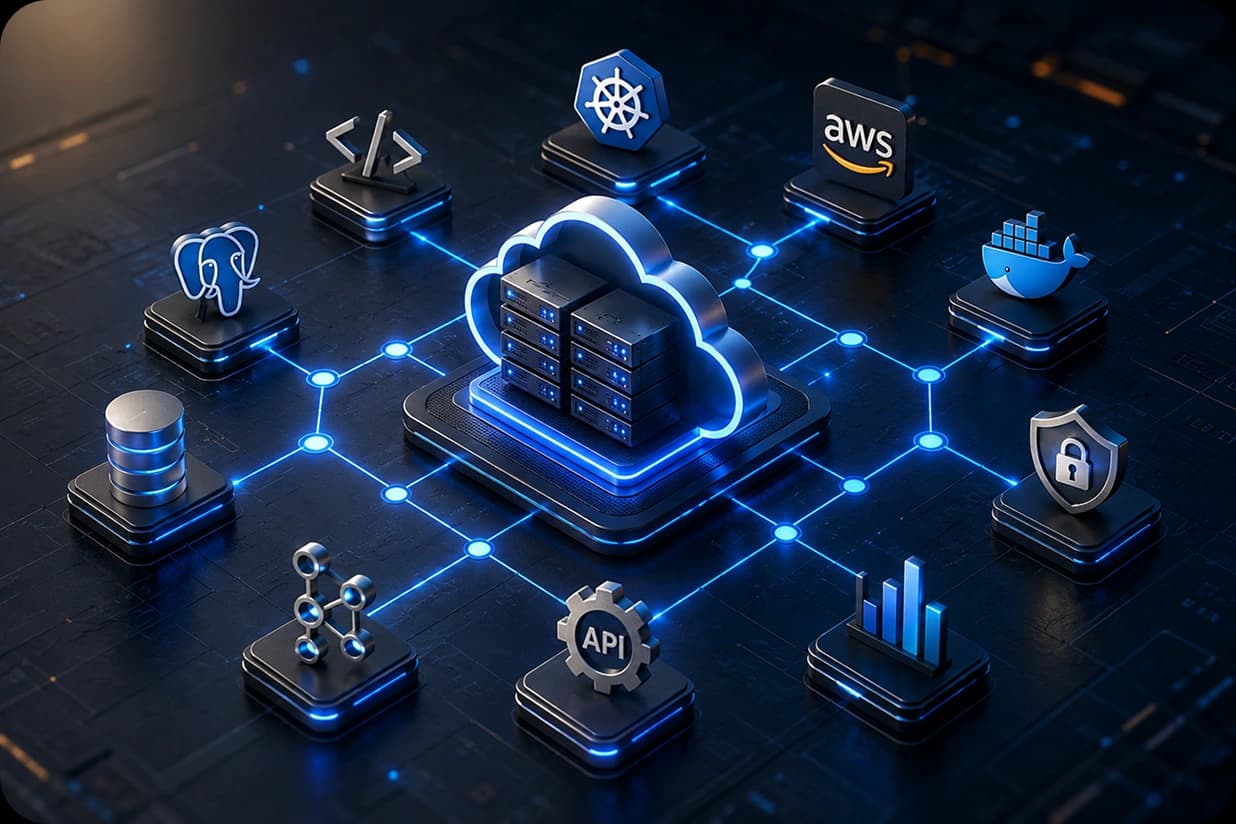
Technologies we build on
Framework and database are architecture decisions, not preferences. We pick each one against your traffic shape, your cost curve, and what your team can maintain after handover.
Why your backend decides everything above it
Your product is only as reliable as the systems underneath it. We have shipped backend systems across education, fintech, travel, media, retail, HR technology, healthcare, conversational AI, and commodity trade, spanning four backend frameworks and four relational database deployments in production.
Four pressures that pull against each other
Most product problems that look like frontend problems are not. A checkout that stalls, a dashboard showing yesterday's numbers, an AI feature costing more than it earns: those are architecture decisions surfacing late.
Backend work is where latency, cost, correctness, and operability meet at once. Users abandon anything slow. Compute and inference bills scale with success. Wrong data is worse than no data. And a system nobody can deploy safely stops improving. Resolving those four concretely, rather than picking one and hoping, is the job.
Architecture chosen against constraints, not fashion
We have built a deliberate modular monolith of roughly 70 feature modules because a shared database schema could not be re-partitioned, and independently deployed microservices where real-time, orchestration, and reporting workloads needed to scale on different curves.
Both are correct answers to different questions. Matching complexity to actual need is part of the service, and it is the difference between a system your team can still change in two years and one they work around.
Migration without a big-bang cutover
One recent engagement delivered 622 API routes across 69 controllers and 68 services in roughly 12 weeks, mapped onto a live 143-table production database with zero schema-altering migrations, because a legacy application still depended on that schema until it could be retired.
Legacy password hashes were made compatible with the new authentication layer so existing users kept their credentials through the cutover. New migrations were tracked separately so they could not collide with the legacy migration history. That is the kind of constraint real backend engineering runs into, and the reason we start with constraints rather than a wishlist.
AI backends that are economically viable
Four distinct AI orchestration backends are in production across our work, and the engineering problems differ genuinely from conventional API work: multi-stage inference pipelines with shared deadlines, hallucination containment through database re-validation of every model-returned identifier, and agent orchestration coordinated with live audio and video sessions.
The economics are engineered too. Content-keyed caching, per-route throttling on unauthenticated endpoints, and per-stage token logging turn cost per request into a number you can query. A public AI feature is a public billing surface, and we treat it that way from the first commit.
Identity is a backend layer, not a login screen
Sign-in is the visible part. The rest is token lifetime and refresh rotation, which service is allowed to mint a token, how one realm is shared across a consumer app and an internal staff tool without leaking either one's permissions into the other, and what happens to an in-flight request when a role is revoked.
We run federated identity on Keycloak realms shared across client applications, OpenID Connect against external providers, phone OTP as its own service, and role-based access control defined per capability rather than per job title. Clients hold a token. The backend holds the rules.
Content and configuration are backend problems too
A headless CMS is a backend service with a schema, an access model, and a cache-invalidation problem, not a content spreadsheet. We build on Strapi where a catalogue changes faster than releases ship: typed models generated from the schema, media on S3 behind a CDN, and localized payloads that stay safe to render.
One travel product runs three independently deployed clients—a consumer app, an internal staff tool, and a web portal—against a single Strapi backend behind one identity realm, with the portal adding its own backend-for-frontend layer so payment keys and OTP flows never reach a device. This site runs on Strapi as well.
Backend development services
Custom backend development
Custom backend development built around your domain rather than a framework's defaults. Modular monoliths when a shared data model makes splitting counterproductive, independently deployable services when teams and scaling needs genuinely diverge. Production work across NestJS on Node, Django and FastAPI on Python, and Java microservices.
API development and integration
REST APIs with versioned contracts, typed request and response objects, and consistent error semantics. Backend-for-frontend layers that keep payment keys and OTP flows server-side instead of shipping them to a client. Integration against payment gateways, identity providers, headless CMS backends, and AI model providers, with cryptographic verification of every inbound callback.
Microservices development
Microservices where the split solves a real problem. We have delivered a modular monorepo separating gateway, file storage, session, orchestrator, and reporting services, and a distributed ERP where independently deployed modules stay consistent through a proxy layer with multi-tier caching, retry with backoff, and request de-duplication instead of a shared database.
Database architecture and development
Schema design, entity mapping, and migration strategy across MySQL 8 and PostgreSQL with TypeORM, Prisma, or direct driver access. Including entity-first mapping onto frozen legacy schemas with explicit column mapping, separate migration tracking, and strangler-pattern cutover so a new stack can run against a production database that is not yet allowed to change.
Authentication, access control, and security
JWT with refresh-token rotation, Passport strategies, and social sign-in through Google and Facebook. Federated identity with Keycloak realms shared across client applications, phone OTP as its own service, and role-based access control with per-capability definitions. Security assessment is part of delivery: we review configuration, secrets management, and access control, and remediate what we find before release.
Performance optimization and cost control
Content-keyed caching in Redis that invalidates the moment a record changes rather than when a timer expires. Pipeline splitting at the real latency seam. A single composed request deadline across a multi-stage operation instead of independent per-call timeouts. Per-route rate limiting evaluated only on cache miss, so abuse protection does not tax cached traffic.
Scalable and real-time architecture
Stateless services holding only per-connection state, so capacity grows by adding instances. Streaming and event-driven services for continuous audio and per-frame events. Background processing with Bull and RabbitMQ to keep slow work off the request path. Real-time transport over WebSocket, bidirectional gRPC, and LiveKit rooms for live audio and video.
AI and LLM backend engineering
Multi-stage LLM pipelines with dependent calls, deadlines, and retry budgets. Hallucination containment through database re-validation of model output. Agent orchestration with LangGraph and LangChain over OpenAI, coordinated with speech-to-text and text-to-speech. Prewarmed runtimes so a live session never pays cold-start cost mid-conversation.
How we deploy and operate it
Containerized deployment
Multi-stage Docker builds with separate development, builder, and production stages running as a non-root user. Docker Compose for multi-service environments with health checks, dependency-ordered startup, and migrate-on-boot, so the same image runs everywhere and release becomes a repeatable operation instead of a checklist someone remembers.
Cloud hosting and infrastructure
We deploy what we build to your cloud. Production experience on AWS with EC2, CloudFront, and S3, and on Azure with Blob Storage, Container Registry, and Kubernetes. Vercel for edge-delivered applications, and self-managed infrastructure with Nginx, Apache, and PM2 where a managed platform would add cost without adding value.
CI/CD and observability
Automated build and image publishing through Azure Pipelines or GitHub Actions, with static analysis in the pipeline and migration steps run as explicit, verified stages. Structured application logging with per-request and per-stage detail, cost drivers instrumented directly, and container health checks so a failing dependency surfaces immediately.
Backend systems we've built
Every system below is in production and was built by CodePrism Technologies. Client and project names are withheld, so each card describes the engineering problem and how we solved it instead. The published case studies linked below carry the full detail.
- Problem
- A live platform needed a new backend, but its 143-table production database could not be altered until a legacy application was retired.
- Approach
- A NestJS modular monolith of roughly 70 feature modules, mapped entity-first onto the frozen schema with explicit column mapping, and new migrations tracked separately so they could not collide with the legacy migration history.
- Engineering proof
- 622 API routes across 69 controllers and 68 services in roughly 12 weeks, with zero schema-altering migrations. Legacy password hashes were made compatible with the new auth layer, so existing users kept their credentials.
- Stack
- NestJS, Node 20, MySQL 8, TypeORM, Redis, Bull
- Problem
- A public, unauthenticated wizard ran five dependent LLM calls, so latency, inference cost, and truthfulness were all in tension at once.
- Approach
- The pipeline was split at its one real thinking-time seam, wrapped in a single composed request deadline rather than per-call timeouts, and fronted by three content-keyed Redis cache layers that invalidate when a record changes instead of when a timer expires.
- Engineering proof
- A repeat identical request eliminates all five model calls and returns at zero token cost. Per-stage token counts, durations, and cache-hit flags are logged structurally, so cost per request is queryable.
- Stack
- NestJS, Redis, structured logging, database re-validation of model output
- Problem
- A live AI-conducted interview had to keep speech recognition, LLM reasoning, speech synthesis, avatar rendering, and recording in sync for the length of a session.
- Approach
- LiveKit agent sessions with prewarmed runtime components, so no session pays cold-start cost mid-interview, and asynchronous handlers so no subsystem blocks another. Behind them, a microservices split across gateway, file storage, interview, orchestrator, and reporting.
- Engineering proof
- A fallback avatar path keeps an interview running when advanced rendering fails outright, instead of failing the whole session.
- Stack
- NestJS, PostgreSQL, TypeORM, Redis, RabbitMQ, LiveKit, LangGraph
- Problem
- Independently deployed ERP modules all needed the same office, location, and role reference data from a central shell, without duplicating it or paying a network round-trip on every request.
- Approach
- A proxy layer with multi-tier in-memory caching, automatic retry with backoff, and request de-duplication, instead of a shared database.
- Engineering proof
- Modules stay consistent with central reference data while staying independently deployable, with no second source of truth to reconcile later.
- Stack
- NestJS, PostgreSQL, Docker Compose, GitHub Actions
- Problem
- Three clients—a consumer app, an internal staff tool, and a web portal—had to share one content and booking backend without any of them holding payment or OTP secrets.
- Approach
- A Strapi headless backend behind a CDN as the shared content store, one Keycloak realm shared across all three clients, and a backend-for-frontend layer in the portal that keeps payment keys and phone-OTP orchestration server-side.
- Engineering proof
- Payment callbacks are verified with server-side HMAC-SHA256 before an order is persisted, and catalogue changes ship without an app release.
- Stack
- Strapi, Keycloak, Next.js route handlers, phone-OTP service, Razorpay
- Problem
- Two real-time audio services had to scale horizontally while avoiding distortion at chunk boundaries and false end-of-turn triggers mid-sentence.
- Approach
- Stateless FastAPI services holding only per-connection state: one pads audio before enhancement and trims after, the other combines a lightweight voice-activity model with a semantic turn-ending model behind a state machine that closes a turn only on stronger evidence.
- Engineering proof
- Documented design targets of sub-two-second text latency, sub-five-second audio latency, and 50 or more concurrent requests. These are repo-stated design targets, not measured production outcomes.
- Stack
- FastAPI, Python, WebSocket streaming, Docker Compose
Talk to the engineers who build these systems
Bring us the API that is slowing down, the schema blocking your roadmap, or the service nobody wants to deploy. You get an architecture opinion and a cost view from the people who would do the work.
Prefer we come to you? Fill in the form below.
Tell us where to reach you
Takes under a minute. An engineer reads it, not a lead-scoring tool.
Why teams choose us for backend engineering
We architect for your constraints
A deliberate modular monolith when a frozen schema made splitting impossible. Independent microservices when scaling needs genuinely diverged. Matching complexity to need is a service, not a compromise, and it decides whether your team can still change the system in two years.
We migrate without a big-bang cutover
A new backend running against a live 143-table production schema with zero altering migrations, while a legacy application still used the same database, meant the business kept operating throughout. Existing users kept their passwords because legacy hashes were made to work with the new auth layer.
We make AI backends economically viable
Content-keyed caching that eliminates every model call on a repeat request. A composed deadline across the whole pipeline. Database re-validation so the system cannot recommend something that does not exist. Per-stage token counts logged and queryable, so cost per request is a number rather than a worry.
We encrypt above the transport layer
For a payments product we encrypted sensitive request bodies with AES-256-GCM and wrapped the symmetric key using the server's RSA public key, decrypted transparently at the backend. Security depth where the threat model justifies the engineering cost.
We solve distributed-systems problems properly
Independently deployed ERP modules stay consistent with central reference data through a proxy layer with multi-tier caching, retry with backoff, and request de-duplication. No shared database, no duplicated source of truth, and no coupling problem that gets worse every quarter.
We tell you where we are weak
Backend engineering is our depth. Cloud work is how we deploy and operate it, not a separate consulting practice we would oversell you. Automated backend test coverage is thin on several systems we inherited, and CI/CD maturity varies. We show you the current state and what improving it costs.
Our approach
Discovery and constraints
We start with the constraints, not the wishlist. What cannot change? Which database is frozen? Which legacy system still has to work? Where does cost scale fastest? Most architecture mistakes are constraints discovered too late.
Architecture and data modelling
We pick the pattern deliberately and write down why. Modular monolith or independent services. Shared database or a reference-data proxy. Then the data model and API contract, because everything downstream inherits both.
Build in reviewable increments
Typed contracts, explicit DTOs, and modular boundaries from the first commit. Code review on every change, including a hard rule that schema-to-entity mappings are verified before merge, because one mismatched column breaks every query against that entity.
Testing and quality gates
Build and lint gates on every change, static analysis where a pipeline exists, unit and end-to-end tooling on our stronger engagements, and a documented manual smoke-test gate before release. Where you want comprehensive coverage, we scope it as real work.
Deploy and monitor
Containerized release to your infrastructure, with structured logging and cost instrumentation from day one, so the first incident is diagnosed from data rather than guessed at.
Optimize against measurements
Caching strategy, query tuning, latency restructuring, and rate limiting applied against measured behaviour. We optimize what the logs say is slow or expensive, not what feels slow.
Ways to work with us
Fixed price
Best for a defined piece of backend work: an API surface, a schema migration, or a service extraction where the scope and the constraints are already settled.
Time and materials
Best when the architecture is still moving and you want to reprioritise between features, latency work, and cost work sprint to sprint.
Dedicated team
Best when you want backend engineers who own a roadmap, a release cadence, and the long-term shape of the system alongside your team.
Staff augmentation
Best for a specific gap: NestJS or Django engineers, a database specialist, or a DevOps engineer joining an existing team.
Backend development agency, in-house, or freelance?
| Factor | CodePrism | In-house hire | Freelance / body shop |
|---|---|---|---|
| Time to start | Days. Engineers who have done the migration before. | Weeks to months of hiring. | Fast to start, quality varies. |
| Architecture judgement | Modular monolith or microservices, argued against your constraints. | Limited to who you hire. | Usually one framework, one pattern. |
| Legacy and migration work | Frozen schemas and live cutovers are routine for us. | Depends entirely on prior experience. | Rarely scoped or de-risked up front. |
| Scaling the team | Flexible, sprint to sprint. | Fixed headcount. | Ad hoc and unpredictable. |
| IP ownership | Yours, contractually. | Yours. | Negotiated case by case. |
| Cost predictability | Scoped, with cost instrumented in the system itself. | Salaries plus infrastructure overhead. | Low rate, higher rework risk. |
| Handover | Typed contracts, tracked migrations, and runbooks you can maintain. | Knowledge stays as long as the person does. | Often undocumented. |
| After release | An ongoing partnership, including operations. | Depends on retention. | Usually ends at delivery. |
Where we have built backend systems
Frequently asked questions
What do backend development services actually include?
API design and implementation, database architecture and migrations, authentication and authorization, background job processing, third-party and payment integrations, caching and performance work, and the deployment setup that gets all of it into production reliably. If your product has a login, stores data, or talks to another system, that is backend scope. The parts teams underestimate are usually the data model and the API contract, because those are the two decisions everything downstream inherits and the two that are expensive to change later.
Which backend technologies do you work with?
NestJS on Node, Django and FastAPI on Python, Java for microservices, and Next.js route handlers for backend-for-frontend layers. On data, MySQL 8 and PostgreSQL with TypeORM or Prisma, Redis for caching and rate-limit state, and Bull or RabbitMQ for queues and background jobs. For real-time we build on WebSocket, bidirectional gRPC streaming, and LiveKit rooms for live audio and video. We pick based on what your team can maintain after we hand over, not on novelty.
Do you offer cloud services, and where do you deploy?
We deploy and operate the backends we build, which is a narrower offer than a cloud consulting practice, and we would rather say so than sell you the wider one. Our production deployment experience is on AWS with EC2, CloudFront, and S3, and on Azure with Blob Storage, Container Registry, and Kubernetes. We also use Vercel for edge-delivered applications and run self-managed containerized infrastructure with Docker Compose, Nginx, and PM2 where a managed platform would add cost without adding value. If you need cloud strategy, a large-scale datacentre migration, or FinOps as a standalone engagement, we are not the strongest choice for it.
Can you modernize or migrate our existing backend without downtime?
That is the approach we prefer. On one platform migration we ran an entirely new backend against a live 143-table production database with zero schema-altering migrations, because a legacy application still depended on that schema until cutover. Legacy password hashes were made compatible with the new authentication layer, so existing users kept their credentials and never knew the platform changed underneath them. The work is incremental and reversible at each step rather than one scheduled big-bang cutover, which is the version that tends to actually succeed.
Should we build microservices or a monolith?
It depends on whether your data model can genuinely be partitioned and whether your teams need to deploy independently. We have built both deliberately. When a shared database schema could not be re-partitioned, a modular monolith of roughly 70 feature modules was the correct answer and we said so. When separate real-time, orchestration, and reporting workloads needed to scale differently, microservices were, split across gateway, file storage, session, orchestrator, and reporting services. You get the recommendation with the reasoning attached, and the reasoning is the part that matters six months later.
How do you keep AI and LLM features from becoming a runaway inference bill?
By instrumenting and constraining them. Content-keyed caching so an identical request costs nothing on repeat and invalidates the moment the underlying record changes, per-route rate limiting and daily quotas backed by Redis and checked only on cache miss, and a single composed deadline across the whole pipeline so a slow model call cannot stack retries indefinitely. Per-stage token counts, durations, and cache-hit flags are logged structurally, so cost per request is a number you can query rather than estimate. On one production pipeline, a repeat identical request eliminates all five model calls and returns at zero token cost.
How do you handle backend security?
Security assessment is part of delivery, not a phase bolted on afterward. We review configuration, secrets management, and access control, and remediate what we find before release. In practice that means credentials in managed environment configuration rather than in source, centralized permission checks instead of the same logic duplicated at every call site, server-side signature verification on inbound webhooks and payment callbacks before anything is persisted, and application-level encryption for sensitive payloads where the threat model warrants it. On a fintech payments product that meant AES-256-GCM on the request body with the symmetric key wrapped using the server's RSA public key.
Do you provide DevOps and CI/CD setup as part of the engagement?
Yes, for the systems we build, and we will be specific about your current state first. Our stronger engagements run automated pipelines through Azure Pipelines or GitHub Actions with static analysis, container registry publishing, and Kubernetes rollout. Others we have inherited had manual release processes we are still improving, so CI/CD maturity across our portfolio is genuinely uneven rather than uniformly strong. Multi-stage Docker builds, health checks, dependency-ordered startup, and migrate-on-boot are the baseline we aim for, so the same image runs in every environment.
What does your automated testing coverage actually look like?
A direct answer, because you would find out anyway: automated backend test coverage varies across our portfolio and is thin on several systems we inherited. What we run consistently is a build and lint gate on every change, static analysis where a pipeline exists, unit and end-to-end test tooling on our stronger engagements, code review discipline including a hard rule that schema-to-entity mappings are verified before merge, and a documented manual smoke-test gate before release. If you want comprehensive automated coverage, we scope it as real engineering work with real hours rather than imply it is already there.
Do you build on Keycloak and Strapi, or roll your own?
We use both, and we will tell you when neither is the right answer. Keycloak is what we reach for when more than one application has to share one identity source: realms shared across a consumer app, an internal staff tool, and a web portal, with OpenID Connect against external providers and role definitions kept per capability rather than per job title. Rolling your own identity layer is defensible for a single application with one sign-in path, and expensive the moment a second application appears. Strapi is what we reach for when a catalogue changes faster than releases ship, with typed models generated from the schema, media on S3 behind a CDN, and localized payloads that stay safe to render. For content that changes twice a year, a CMS is overhead and we would rather put the content in the repository.
How do you engage, and how is backend work priced?
Four models, picked against how settled the scope is. Fixed price suits a defined piece of work: an API surface, a schema migration, a service extraction. Time and materials suits a system whose architecture is still moving, where you want to reprioritise between features, latency, and cost work sprint to sprint. A dedicated team suits a long-term roadmap you want engineers to own. Staff augmentation suits a specific gap, such as NestJS or Django engineers or a database specialist joining your team. Discovery comes first in every case, because a backend estimate written before anyone has seen the schema and the integration surface is a guess, and we would rather give you a real number a week later than a comfortable one immediately.
Explore our other services
Web applications
Frontend applications that consume the APIs and services we build.
Learn moreMobile applications
Mobile apps that connect to your backend through the APIs we design.
Learn moreGenerative AI
AI services integrated into your backend: inference pipelines, RAG infrastructure, and agent orchestration.
Learn moreLet's talk about your backend project
Bring us the constraints, including the ones you think are embarrassing. Frozen schemas, legacy systems that cannot be turned off, manual deploys nobody wants to touch. We have built inside all of them.
Prefer we come to you? Fill in the form below.
Tell us where to reach you
Takes under a minute. An engineer reads it, not a lead-scoring tool.